

To have your say, please email your comments to editor@langdyke.org.uk
‘Please join our debate’
 Here’s a chance for you to have a say … to encourage you to put forward views about all things nature. You might want to tell us about your wildflower garden, inform us of something you’re proud of or just have a chance to get something off your chest …
Book Club: Our antidote to a busy modern life
By Claire Noble
Langdyke events organiser
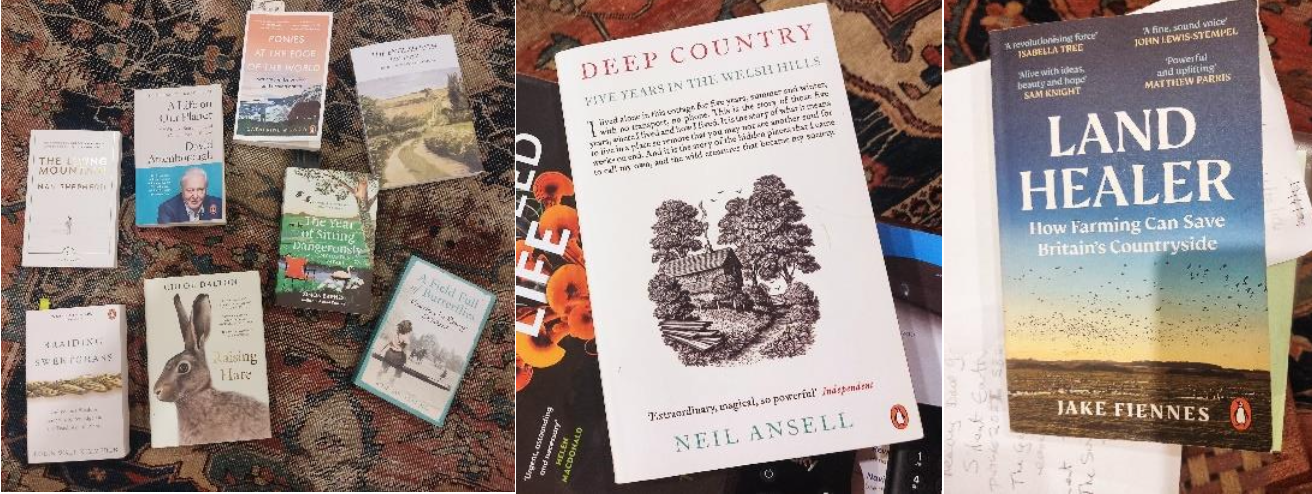
March book club was all about solitude and reflection as an antidote to a busy modern life and our connection to the natural world, how it has changed, why it is fundamental, and how we can all serve nature.
Top reads; Wild Service by Nick Haynes, Deep Country by Neil Ansell, The Living Mountain by Nan Shepherd Land Healer by Jake Fiennes and Losing Eden by Lucy Jones.
Top audiobooks; The ServiceBerry by Robin Wall Kimmerer, and Next to Nature by Ronald Blyth.
On the coffee table; A year of Sitting Dangersously by Simon Barnes, Raising Hare by Chloe Dalton, Ponies at the edge of the World by Catherine Munro and The English Path by Kim Taplin
Book shop recommendation Toppings of Ely
Local re-wilding projects; Wilder Doddington, Wild Wrendale and Boothby Wilding.
Wild Service by Nick Hayes and Jon Moses and the many ways of serving nature. The self-appointed guardian of a slice of river and the first to notice the changes and a folk music revival and the impact of enclosure on the connection to the landscape and nature.
Finding a moments peace in a busy life reading about solitude with Deep Country by Neil Ansell and the exploration of escape, isolation, the seasons, the landscape and birds of prey.
A life on our planet by David Attenborough, the accidental presenter the long-time observer and scientific observation compared with Jane Goodall and her practical approach.
A new favourite is emerging with Nan Shepherd’s The living Mountain – a meditation on the magnificence of mountains. A talented writer who was discouraged and published and enjoyed success late in life and many years after writing the book.
The English Path by Kim Taplin on the importance of footpaths and their prominence in poems and literature of the 19th century.
Land Healer with farming, wildlife and nature recovery on a country estate.
Losing Eden by Lucy Jones with generations and the disconnection to the landscape and nature, thescience of biophilia and the human interaction with micro-organisms.
The Serviceberry exploring the economy of abundance and reciprocity, serving nature and learning from the wisdom of the natural world the interactions of plants and animals and the cycle of life.
The critical importance of having First Aiders
By David Cowcill
Langdyke trustee
We probably all have a first aid kit – in the car, in the knapsack for hiking, or at home. However the normal content of plasters, bandages and some antiseptic creme is very limited. Despite not having any employees, Langdyke Countryside Trust has the equivalent duty of care of an employer to all its volunteers and by extension all event participants.
It has to be prepared in terms of scenarios, kit and competent trained first aiders for all possibilities across all its sites. That is why seven volunteers spent a rather damp and cool day in the outdoors at Torpel recently to hone their outdoor first aid skills.
Taking the themes in order:-
Scenarios.
Given the typical work-party or event the main severe risk headings are cardiac and collapse (sorry – age profile of participants), trips and falls (brambles, tree stumps, rough ground) , lacerations (sharp tools, saws strimmers and brush cutters), burns (bonfire stoking) and drowning (water bodies on most of the reserves). Then there are another set of issues – heat stroke/exposure, bites and stings, minor cuts, eye injury etc.
First Aid Kits
Both Eastern and Western Reserves have a hierarchy of kits – a main “big pack”, a burns kit, a smaller carry pack (also for off-site events) , and bum-bags for the basics. Taken together they try to address the risks. Their contents include splints, trauma bandages, all sorts of dressings, blankets torches and whistles (it may be some time before help arrives). The latest addition is two defibrillator kits giving extra capability in case of cardiac arrest or need for resuscitation.
Trained First Aiders
The standard workplace training offering does not meet the outdoor need, so LCT has twice signed up for training from accredited outdoor specialists. Certification lasts for three years, so following an earlier training round in 2019, eleven LCT volunteers completed a course in February 2023 covering Emergency First Aid at Work and also Forestry First Aid (the outdoor/equipment angle). Seven of the volunteers then participated in a follow-up session at Torpel in October (damp and cold!) designed to develop the skills in a realistic outdoor setting. The “wounds” were synthetic and simulated, and the action can be seen at https://www.facebook.com/DecisiveFirstAid – the Facebook page of trainer Andrew Barras of Decisive First Aid – an ex paramedic (scroll back to 24/25 October).
It has to be remembered that the volunteers are NOT paramedics and that the emergency services are the best and necessary solution in case of need. However the goal is to maximise the safe and successful care for any casualty until emergency assistance arrives in severe cases, or a minor incident occurs and does not develop into a serious outcome. This includes such basics as location and access details for the reserves, and incident/role management to maximise chances of successful care.
Finally an irony. The hope has to be never to put the training into practice. As volunteers how do you keep the knowledge and confidence to apply it alive and deliverable at a moment’s notice? Perhaps the answer is good risk prevention and arranging a refresher course annually rather than the three years of the certification.
Little Miss Muffet didn’t see this coming …
by Jackie Robinson
Langdyke volunteer
I bet Little Miss Muffet didn’t see one of these from her tuffet, a Wasp spider, Argiope bruennichi.

This one was spotted by chance at Swaddywell Pit Nature Reserve when I was trying to get a close-up shot of a grasshopper. The only reason I spotted it, even though it is so brightly coloured, was because the said grasshopper jumped straight into the spider’s web and was neatly wrapped in a tight parcel in about half a second.
This large, colourful spider is a fairly recent arrival in the UK from the continent and is slowly spreading through England though mainly in the south. It builds large orb webs in grassland and heathland, and attaches its silk egg-sacs to the grasses. The web has a wide, white zig-zag strip running down the middle, known as a ‘stabilimentum’, the function of which is unclear.

Mating is a dangerous game for males, who are considerably smaller and not colourful; they wait at the edge of the web until the female has moulted into a mature form, then take advantage of her jaws being soft and rush in to mate. However, many males still get eaten during this time.
The female has yellow, black and white stripes, just like a common wasp. Its legs are also stripy. The male is much smaller and pale brown. (Wildlife Trust)
After I posted my photo on the Langdyke Facebook page others went to look for her and found some others nearby. We have a wealth of flora and fauna on the Langdyke Reserves, we are so lucky to have these areas to visit so close to home. Many local people have never visited or even know about these wonderful places. Until last year I had never visited any of the reserves and I’ve lived in Helpston for 18 years. I now volunteer as a work party member at Swaddywell on a Thursday morning. It is great to be so involved.
Membership of the Langdyke Trust offers opportunities to see, hear and be involved with wildlife that you would never have thought possible. I’ve heard Nightingales, seen three types of newt, Glow worms, butterflies and so many insects, wild flowers, orchids and fungi that I would not know where to start to describe them, (I have a few photos though) and I’ve also met some wonderfully talented people and various experts on walks and other organised events.
Sharing books and getting inspiration from other Langdyke members
By Claire Noble
Events organiser
October’s Langdyke’s nature book club was full of joy and hope as the group shared books of journeying, foraging, pilgrimage and wombling. The cabin at Torpel was shrouded in fog and there was a lot to cover so, wrapped in coats and blankets we had a good old catch up over warming cups of tea and cake.
Sitting in the cabin on the site of Medieval Torpel Manor, it seemed appropriate that we should start with, The time Travellers Guide to Medieval England by Ian Mortimer, an enjoyable and fascinating read about a time in our own history with very different culture and customs. A number of the group are reading books on foraging including, Edible and medicinal wild plants of Britain and Ireland by Robin Harford and, The Foragers Calendar by John Wright and we had the opportunity to hear about and see examples of natural dyes including blackberry and Reed flower, from Kathryn Parsons, one of Langdyke’s very talented Artists in Residence.

Journeying and pilgrimage featured in a number of books with recommendations for, The Phone Box at the edge of the World by Laura Imal Messina, a hopeful, fascinating and touching story of the weather, sea, place, loss and connection. Raynor Winn passed to another member of the group with, The Salt Path, Wild Silence and Land Lines reminding us that journeys are not always predictable and adapting to change can lead to a greater experience. Next up, Way Makers, an anthology of Women’s writing about walking by Kerri Andrews, a good book to pick up and put down including extracts from Dorothy Wordsworth and Kathryn May and finally, Where the Wild Flowers Grow by Leif Bersweden, a highly recommended book for those with a love of botany.
The Book of Hope reminded us of the inspiration that is Jane Goodall, still travelling and working with communities today. On The Marsh by Simon Barnes is a personal story of family, devotion and nature conservation on a small marsh in Norfolk over the course of a year and for children (6 to 10 years) The Wombles collection of 6 books by Elizabeth Beresford is highly recommended. Elizabeth Beresford was tackling issues of littering, pollution, and climate change in 1973 and the stories stand the test of time, with a Womble for everyone.
Our book club is relaxed and all are welcome to come along and share their favourite books or just to listen to others and take inspiration.
Keep an eye out for the December book club on the Langdyke website and on the Langdyke facebook page.
‘Our role in Peterborough local plan’
By Richard Astle
Langdyke and John Clare Countryside chair
An open letter response to Peterborough City Council’s local plan consultation process.
I am writing on behalf of key partners in the John Clare Countryside (JCC) to request that the project is recognised within the Local Plan as a key initiative to support the future sustainable growth and development of Peterborough and a critical enabler for many of its objectives.
The JCC concept was originally established in 2009 and was relaunched in 2019. It has the support of the City Council, our constituency MP, Natural England, Natural Cambridgeshire, The Wildlife Trusts, Milton Estate, Burghley Estate, Walcot Estate, Tarmac, Nene Park Trust, the Langdyke Countryside Trust, PECT, Sacrewell Farm and many of the parishes in the area.
Peterborough City Council has previously endorsed the JCC and the Doubling Nature ambition at Full Council. The area is also one of Natural Cambridgeshire’s six priority landscapes.
Between September 2021 and March 2023, the project was in receipt of a grant from the National Lottery Heritage Fund Green Recovery Challenge Fund.
In particular, the John Clare Countryside can significantly assist with the following objectives in the Local Plan
Local economy – the JCC has a specific objective to help landowners and tenant farmers in the landscape area to prosper, setting an example of how sustainable farming and rural diversification can not only co-exist but also benefit from the opportunities provided through nature recovery programmes.
Climate change adaptation and flood risk – the JCC’s plans include the creation of new wetlands, grasslands and woodlands, which will capture carbon and alleviate flood risk.
Biodiversity, Geodiversity and Green Infrastructure – the JCC (and partners) will be a crucial enabler of the achievement of this proposed objective. The area includes some of the most nature rich areas of Peterborough, specifically the two national nature reserves at Barnack Hills and Holes and Castor Hanglands, plus eight Sites of Special Scientific Interest and 68 County Wildlife Sites. Our plans for landscape scale nature recovery, which are supported by key landowners, envisage the creation of significant areas of additional nature rich habitat and corridors between them. Our parish nature recovery plans also enable local people to make a tangible difference to their local communities through smaller scale environmental projects.
Historic environment – the JCC aims to develop a co-ordinated network of well-kept heritage sites, linked through the figure head of John Clare, accessible to all and working together to involve and attract visitors and to support literary and artistic work and literacy.
Land and soils – the JCC aims to pilot and champion best practice sustainable development in all aspects of future development within the area including sustainable techniques of land management both on and off the existing nature reserves.
In addition, the John Clare Countryside will support health and wellbeing objectives, through its focus on promoting greater opportunities for the people of Peterborough to access and enjoy nature rich countryside. It will also provide a significant destination for visitors, anchored on the natural and build heritage of the area, co-ordinated under the umbrella figure head of John Clare.
Given this close alignment of the John Clare Countryside with the objectives proposed in the Local Plan, we feel that the John Clare Countryside should be explicitly recognised in the Plan as a key enabling initiative and embraced within the Council’s own strategic thinking and priorities for the future of the city and its rural areas.
The John Clare Countryside is a significant asset to Peterborough and its people, with the potential to enhance biodiversity, the rural economy, sustainable tourism and to offer a high quality accessible green lung for the people of the city. It should be recognised as a key part of the growth agenda, as a place for nature, sustainable tourism and recreation and commercial farming.
The John Clare Countryside area is not, therefore, an appropriate location for large scale housing or commercial development. In particular, we believe that there should be no development that impacts adversely on the aims of the John Clare Countryside or on the key nature sites, specifically those with existing designations such as the National Nature Reserves, SSSIs and County Wildlife Sites.
This response has been seen and approved by
- Bainton Parish Council
- Castor Parish Council
- Langdyke Countryside Trust
- Wildlife Trust BCN
- PECT
- Nene Park Trust
- Sacrewell Farm
- Sutton Parish Council