
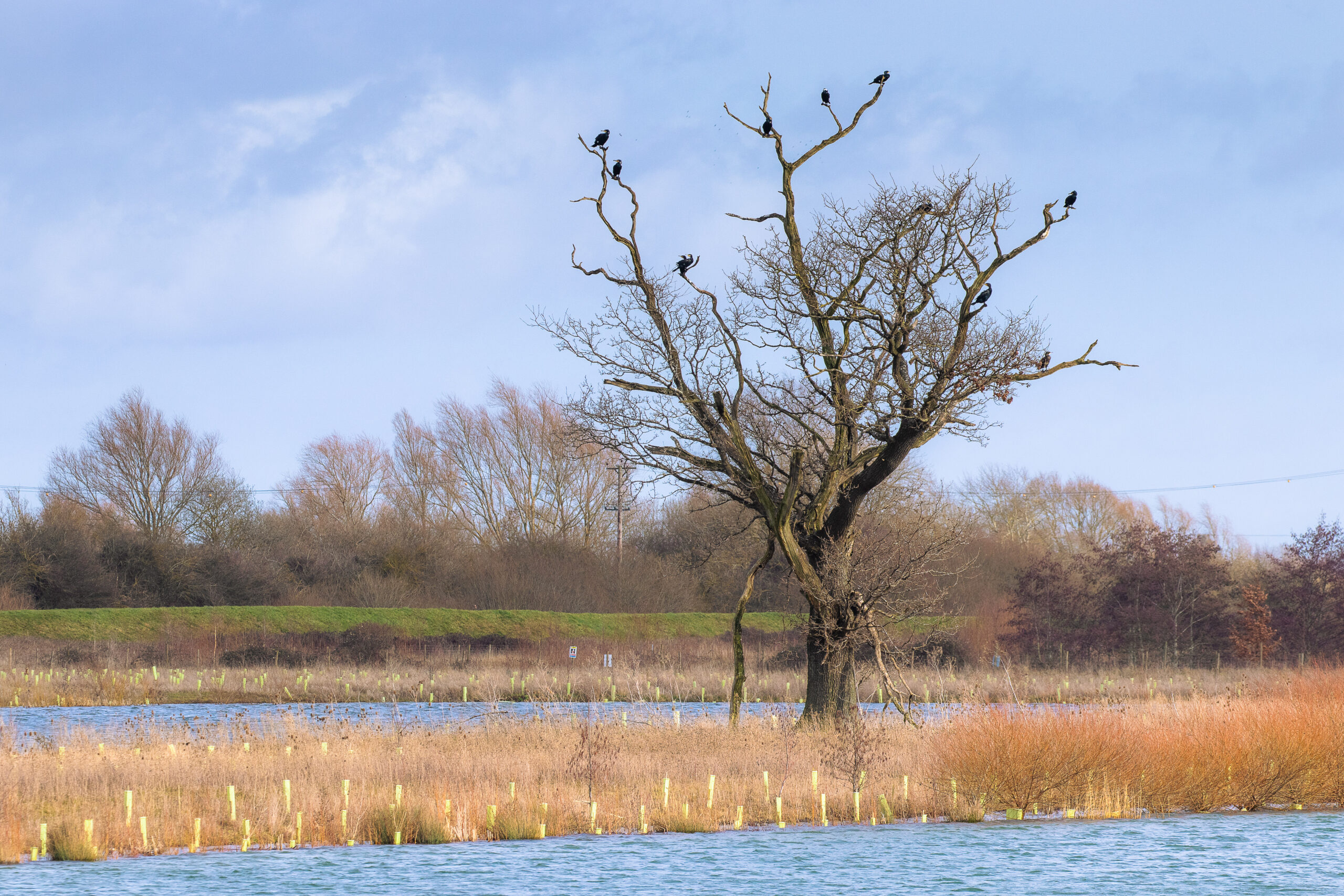
A really valuable wildlife site
Initial surveys suggest that although only recently established the site already meets the criterion for being considered for County Wildlife Site status on botanical grounds alone (sixteen submerged and emergent wetland plants have been recorded).
A total of 116 plant species was recorded from a single visit in August 2022, following an intense drought and with much of the vegetation mown. Additional species are undoubtedly present. A record of Inland Club-rush Bolboschoenus laticarpus during the August survey was the first for the Vice County of Northamptonshire.
The aquatic and wetland fauna is of high value and considerable interest, albeit that the assemblage so far recorded can probably be regarded as characteristic of recently abandoned gravel pits in the area rather than exceptional.
The site is also important for wintering duck, including gadwall, mallard, wigeon, teal and shoveler. Tufted duck and mallard also breed, as do great crested and little grebe.
Snipe and lapwing are found in winter, with lapwing also using the site to feed during the breeding season (they nest on the neighbouring fields).
The pits also provide a feeding site for swifts and hirundines, as well as grey heron and little egret.
Redshank, and Common and Green sandpiper also use the margins of the pits on migration. Little owls bred in the oak trees until very recently and barn owls hunt over the grassy areas.
Otters are often seen very close to the site, and in the neighbouring Maxey Cut, and may well use the site to breed, feed or rest. Both Water Shrew and Harvest Mice have been recorded close by, and may be present on the site.
Badgers are known to use the paths on Maxey Cut and the surrounding farmland, as do Brown Hare, Muntjac and Roe Deer.
Of particular significance are the populations of four spotted moth and glow-worm which are found on the adjacent areas of the Maxey Cut. The four spotted is a UK BAP priority and red-data book species. In the summer of 2022 surveys along the Cut by members of Butterfly Conservation revealed important numbers of the moth feeding on field bindweed on its banks. Surveys of glow-worm have also detected regionally significant numbers of this beetle on the Maxey Cut in the areas immediately north of Christ’s College Pits.
The wider area is also very important for another red data species, turtle dove. Langdyke already operates within the framework of the RSPB’s Operation Turtle Dove to sustain what is one of the densest concentrations of this species in the region through habitat creation and supplementary feeding. In summer 2022 at least five calling males were detected in the area between the Helpston-Maxey and Etton-Maxey roads, including on the Trust’s three current reserves. Supplementary feeding takes place on the Etton Maxey reserve.
If Langdyke is successful in purchasing Christ’s College Pits, its management plans for the site would be focused on providing additional habitat for three key species. The site is ideal as nesting habitat for turtle doves and simple management of its northern areas should provide additional habitat for four-spotted moth and glow-worm.
Langdyke is fund raising to buy this valuable nature site. You can help by making a donation. No matter how large or small the amount, you will be helping to save this site from future development …
