
March 2024 update
By Richard Astle
Work across the John Clare Countryside to address the climate and biodiversity crisis continues to accelerate, with active projects in all parishes and with more landowners and farmers involved than ever before.
Key highlights include:
- A busy planting season, with hedges, trees, bulbs and wildflowers planted.
- New nature reserves on the horizon at Christ’s College Pits, between Maxey and Helpston.
- A new partnership to celebrate the Maxey Cut as a focus for nature recovery as well as a vital flood defence.
- Several grants awarded as part of PECT’s 30 for 30 Fund
- Local landowners have commissioned a study to create a Masterplan of how the area might look like as a result of this nature recovery programme. The ambition is to create flourishing nature rich countryside alongside profitable, sustainable farming.
Introduction
The John Clare Countryside Project aims to create an ambitious and accessible nature recovery area, famous for nature thriving alongside sustainable farming across the landscape areas west of Peterborough to the A1, south to the River Nene and north to the River Welland, designed, led and supported by residents, landowners, farmers, businesses and parish councils of the area.
The John Clare Countryside is a significant asset to Peterborough and its people, with the potential to enhance biodiversity, the rural economy, sustainable tourism and to offer high quality green open space for the people of the city. It should be recognised as a key part of the city’s future agenda, as a place for nature, sustainable tourism and recreation and commercial farming.
During 2022 and 2023, the project benefited from a substantial grant from the Government Green Recovery Fund, and was able to accelerate its work, particularly at community level. A full report of the work completed during this period can be found on the John Clare Countryside website – https://johnclarecountryside.co.uk/projects/
This update aims to give a summary of recent work and of plans for the future and to demonstrate the importance of the project to local landowners, farmers, communities, residents and visitors.
Community Nature Recovery Plans
Every parish in the John Clare Countryside has a nature recovery plan and the communities are now taking this forward both individually and as part of parish clusters, each supported by one of the key partners in the JCC project. The clusters meet quarterly, and the cluster leads also meet to discuss how we can work together, share best practice and identify funding opportunities. The clusters are as follows.
| Area | Lead Organisation | Parishes |
| Nene | Nene Park Trust | Sutton, Ailsworth, Castor, Marholm |
| North | Langdyke Countryside Trust | Deeping Gate, Deeping St James, Etton, Helpston, Maxey, Uffington |
| East | PECT | Glinton, Northborough, Peakirk |
| Welland and Whitewater | BCN Wildlife Trusts | Bainton, Barnack, Ufford, Southorpe |
| West | Natural England | Wittering, Thornhaugh, Wansford, Wothorpe |
Northern Cluster
Helpston Nature Recovery Group
- The team replanted the hedgerow along Heath Road, which had suffered badly in the drought of 2022 and hope to plant on the opposite side of the road this year.
- Trees were planted in the churchyard and cemetery and a wildflower area created.
Etton Nature Recovery Group
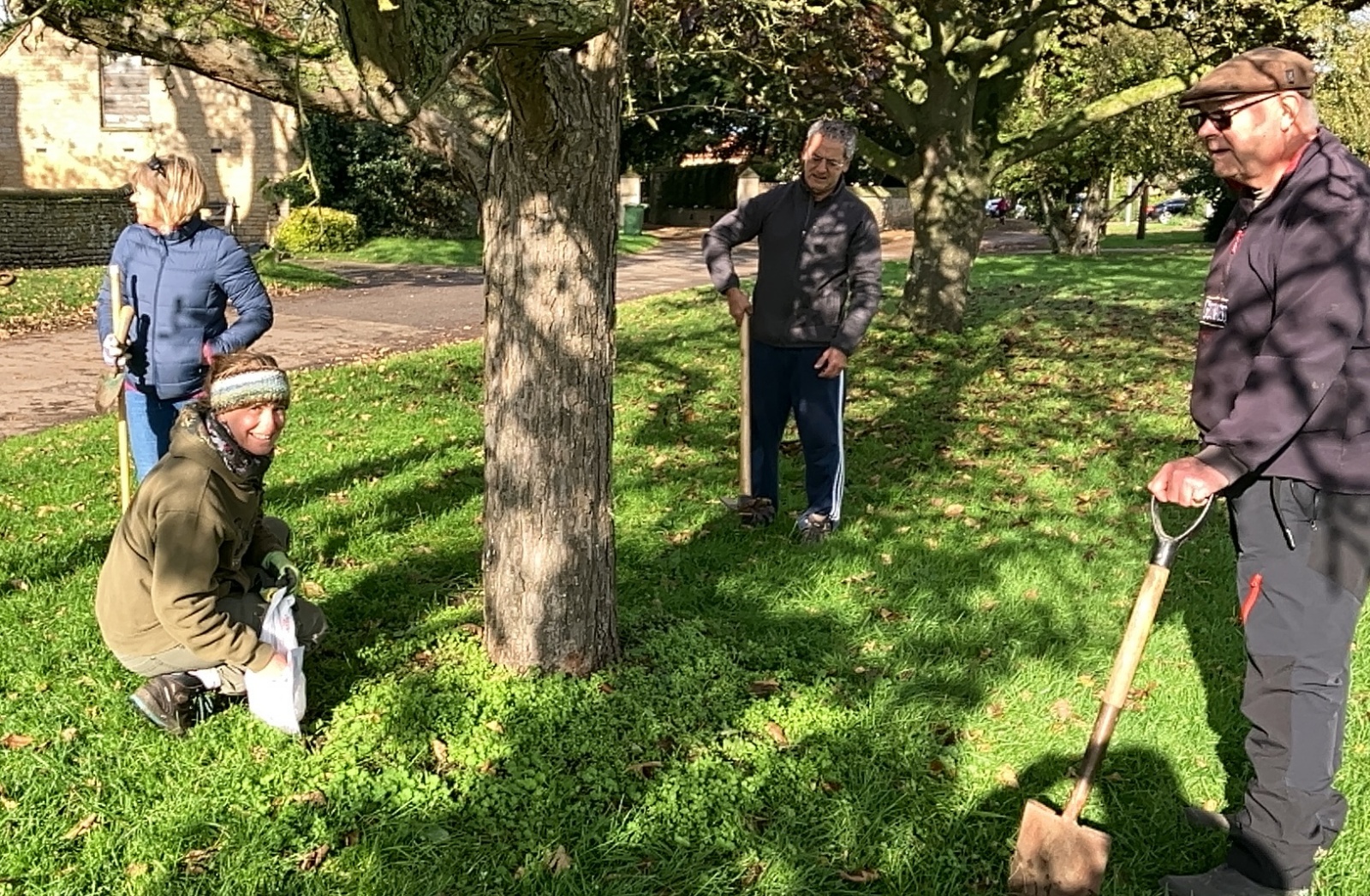
- Bulbs were planted on the village green and other verges in the village – see main picture
Maxey Nature Recovery Group
- Hedgerow maintenance and infilling in Maxey.
- On-going work at the churchyard
- Bulb planting across the village
- Maxey Village Field flower patches had extra plug plants to provide colour.
Uffington Nature Recovery Group
- Major bulb planting day held in December 2023.
Nene Cluster
Castor Nature Recovery Group
- Thanks largely to a grant that we received from PECT, we’ve been able to purchase bird boxes, bug hotels, native wildflower bulbs, plug plants and wildflower seeds that will both increase the choice of nesting areas and add to the overall diversity of native wildflowers and insects in and around the village.
- The Standing Stones wildflower area had a ‘make over’ this Winter, and seed from several species of low growing native wildflowers were sown, as well as over two hundred bluebell bulbs being planted there.
- The five-metre wildlife pond in Castor Copse continues to do well, and even though it’s less than three years old, this spring it has around seventy clumps of frogspawn in it, as well as a small population of Great Crested Newts and several dozen Smooth newts calling it home
- A new, sixty-metre-long double hedgerow was created over the winter months by removing encroaching scrub from local reserve Marholm Field Bank using tree poppers and was then pruned and replanted at a site in Splash Lane.
Ailsworth Nature Recovery Group
- Cut and collect work completed on recreation ground with Nene Park Trust (NPT) support
- Planted apple trees as part of Kings Orchard. Will also be sowing more wildflowers.
- Keen to find out potential for digging a pond. NPT have shared contact details for Helen Bailey from WT.
- Have continued to increase volunteer base to support the ongoing work.
- Looking to make some decisions on future of ‘16 acre field’ where there is a lot of potential for Nature Recovery
Sutton Nature Recovery Group
- Trees planted and wildflower seed sown inc. Yellow Rattle on recreation ground. Trees growing very well.
- Nene Park Trust supported cut and collect work on recreation ground. Looks like floristic diversity is already increasing.
- Clearance of hedge line near river. Looking to lay hedge with volunteers
- Hope to create a wetland area. In discussions with farmer to purchase/lease land.
- Bulb planting – Have been asking villagers to plant their ‘patch.’ Looking to plant from Nene Way to Drift.
Marholm Nature Recovery Group
- Spring bulbs planted were few and far between this year, hoping they spread more next year. Looking to try and plant more bulbs in the village green.
- Potential to do some restoration work at the field pond next to the farm on Milton Land.
- Looking at opportunities to plant along the fringes of the walk to the church.
Eastern Cluster
- The orchid-rich Glinton Triangle, to the north of the round-about was successfully cut in March and will be managed to encourage the spread of the orchids this summer.
- Tree planting in West Deeping in partnership with the Environment agency.
- Tree planting plans for and along the Maxey Cut are being discussed with the Environment Agency.
Welland and Whitewater Cluster
Bainton and Ashton Parish Nature Recovery Group:
- Ongoing sensitive management of the village verges is giving a year-by-year increase in plant species diversity and spread. Sensitive management of the Bainton Green Road County Wildlife Site verges with the aim to increase the area of species-rich neutral grassland in good condition began in 2022 and is continuing.
- Work to replace the fences at the historic Sheepwash site is progressing but has been slowed by the very wet winter conditions. Introduction of appropriate pond plants into the sheepwash pool is planned to improve water quality for pondlife. New signage is planned to acknowledge the grants from Milton Estates and John Clare Countryside. Other signs to explain the historic significance of the Sheepwash and the work being undertaken to increase biodiversity in this area are hoped for, a grant will be needed. A memorial bench seat for quiet enjoyment of the area, is being donated by a village family once the fencing has been completed.
- Discussions are taking place with Peterborough City Council to find ways to deter drivers from parking on the Highfield Road CWS verges and to restore these compacted areas, which have become species poor, to species rich grassland.
- The Bainton and Ashton Nature Recovery Group continue to meet regularly and have an active input to the JCC Verges Sub-group and the local Cluster Group.
Barnack Nature Recovery Group
Nature recovery activities in 2024 in Barnack will largely be confined to monitoring the results of activities carried out recently in the parish. We made a second attempt last year to spread the orchid-rich meadow community in the cemetery to a nearby site, using green hay. Our first attempt, two years previously, was disappointing, so we’re hoping for better news in the coming spring and summer. We are monitoring the churchyard after changes in vegetation management there. We will also be continuing to record the colonisation of the limestone mounds in the ‘mock Hills and Holes’ in the new Sissons Close estate. These were created as a condition of the housing development, with the aim of compensating for the anticipated extra public pressure on Barnack Hills and Holes National Nature Reserve.
Ufford Nature Recovery Group
In 2024 are reviewing past hedgerow surveys and identifying opportunities for planting and better management ahead of next winter. Also planning how to make the churchyard better for biodiversity. Previous no-mow periods have shown that the grassland is species-poor so presents as a blank slate.
Western Cluster
Wittering Nature Recovery Group
Wittering Parish have been working with contractors who manage the estate for the MOD to develop proposals to improve the management an area of the village for wildlife. Some tree, scrub and bulb planting was carried out last year. Ideas include supplementing this planting and reducing cutting regimes to let areas of grass grow longer during the summer to be a haven for invertebrates. Sophie van der Bergh Project Officer for the Rockingham Forest Building the Links Project Building the Links for Rockingham Forest attended their last parish meeting to explain more about the project and the support she could offer to develop their parish nature recovery plan building on the work Mike Horne started.
Wothorpe Nature Recovery Group
Wothorpe Parish have quarterly Nature Recovery and Biodiversity meetings They are making good progress building the engagement and awareness within the Parish. They have been working closely with Burghley Estates, wish to undertake a nature audit so that they have a good reference point on the status of our Parish and local areas nature and are continuing to develop a nature circular walk. Plans include the installation of new accessible gates, improvements to paths, better habitat management initiatives to get community engagement e.g. litter picks.
Working with Landowners and Farmers – Nature Recovery Projects
The project is actively supported by the major local landowners and also involves individual farmers and smaller landowners. Several hedges have been put in this year on private land, including along Heath Road, Helpston and south of Top Lodge Farm, near Upton.
Local landowners are actively working together to see how more nature rich habitats can be created on their land. The new agricultural subsidy regime and other government initiatives to foster nature recovery is actively encouraging them plans for woodland planting, wetland creation and the restoration of nature rich grasslands. Already plans are being discussed for wetland creation projects and potentially for creating new habitats to link up the key wildlife sites at Barnack Hills and Holes, Castor Hanglands and Swaddywell Pit.
The landowners have commissioned a study to create a Masterplan of how the area might look like as a result of this nature recovery programme. The ambition is to create flourishing nature rich countryside alongside profitable, sustainable farming.
Other projects
The Langdyke Countryside Trust has entered into a partnership with the Environment Agency looking to the long-term development of natural habitats in the area around the Maxey Cut. The partners are focusing initially on creating an online trail that will help visitors understand not only the natural richness of the area, but also the management of the Cut itself and the rich heritage of the landscape, from the Bronze Age through to Westings Meadow, and the beautiful churches that can be seen from the Cut.
Langdyke also hopes to complete the purchase of a new 22-acre reserve at Christ’s College Pits before the end of April, creating a new community nature reserve along the Maxey Cut. It is also creating a new visitor viewing platform with disabled access at its Vergette Wood Meadow reserve later this year and creating three new ponds on its Etton High Meadow reserve.
Celebrating Community and Nature with the PECT 30 for 30 Grant Fund
Spring is in the air, and the Parish’s are abuzz with excitement in part thanks to funding as part of the PECT 30 for 30 Fund. As part of the 30th anniversary celebrations, the fund is empowering local initiatives within a 30-mile radius of Peterborough, with grants ranging from £250 to £1000. Five projects across the JCC area obtained funding, which includes:
- Castor Parish Council – Pollinators and Passerines:
- Planting 2,250 English Bluebell, Winter Aconite, and Snowdrop bulbs.
- Sowing a mix of twenty native low-growing wildflowers in grass verges.
- Nesting boxes for Passerines family of birds
- Peakirk Parish Council – Understanding Our Village Environment:
-
- Conducting a ecological baseline survey of various village areas.
- Planning future maintenance, improvements, and securing funding.
- Maxey Parish Council – Maxey Village Enhancements:
-
- Installing planters at village entrances.
- Enhancing signage for the Village Field and a map of the paths around the field and information about the variety of nature which can be seen
- Deeping Gate Parish Council – Enhancing the ‘Mini Forest’:
-
- Installing a bench and interpretation signage along the River Welland.
- Uffington Village Hall – Engaging People with Nature and Local Food:
-
- Improving a wildlife area for bees.
- Enhancing an existing pond’s value for wildlife.
- Planting additional fruit trees.
Total funding of around £4k. For more information, visit the PECT 30 for 30 Fund page.
Road Verges Group
This group aims to improve the numbers of wild flowers on road verges in our area and help them spread along the road system. It’s last meeting in March 2024 focused on looking at the appropriate cutting regime for protected verges and trials in Bainton and Barnack to encourage new areas of wild flowers. Peterborough City Council has recently secured funding to increase the number of cuts on these areas through a Biodiversity Net Gain payment from a local brownfield site.
Contact
For further information on how to get involved, contact: Richard Astle, chair, John Clare Countryside Partnership – chair@langdyke.org.uk
Or visit the website www.johnclarecountryside.co.uk