
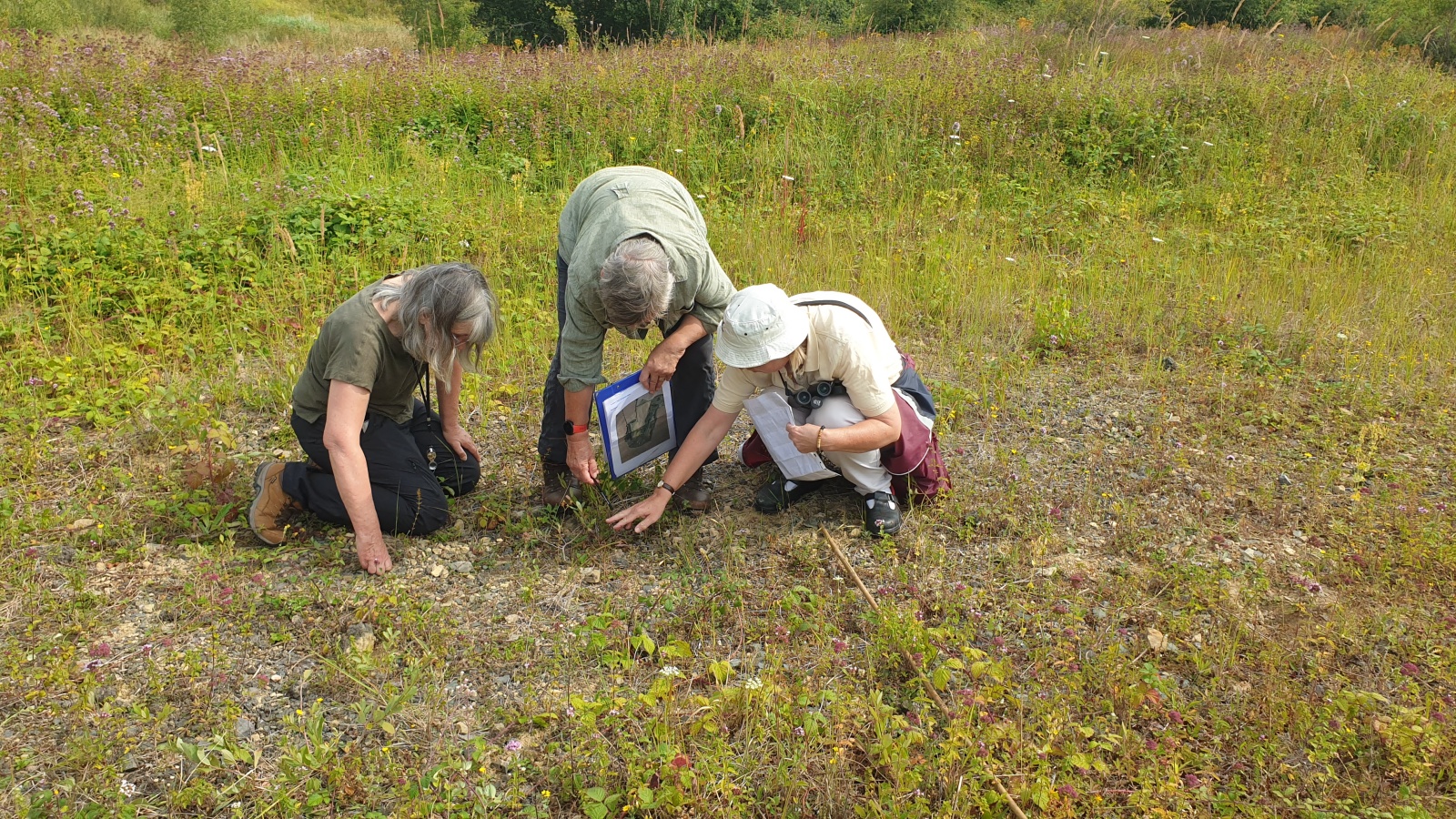
You might ask what’s going on here? In her regular monthly column updating what’s happening on the reserves volunteer Jackie Robinson explains that it’s all in the interests of biodiversity …

A few weeks ago after an initial introduction to grassland monitoring by Sarah Lambert, four of us – from the Swaddywell volunteer workparty – spread our canes on the grass in a cross to make a monitoring quadrant.
Sarah had prepared a sheet for us with the plants to look out for and record within the quadrant.
There were also other things to record a percentage for i.e. brambles, rose and excessive thatch. These chosen areas were recorded with a what3words location to make sure that in three years’ time the exact same area will be monitored again and the recordings will be compared to previous results.
The reason for doing this monitoring is to check the reserve for biodiversity and if certain areas are becoming overgrown with shrub or increased amounts of thatch that are choking plants we can arrange our workparties to attend to this.
The plants we are looking out for are good indicators of a healthy biodiversity and monitoring also helps us to keep an eye on any invasive species, one being the cotoneaster that grows horizontally and completely covers the area.
Some of the plants we had to look out for were Agrimony, Bee Orchid, Blue Fleabane, Common Centaury, Common Knapweed, Eyebright and Mouse-ear Hawkweed. There were 28 species in all to check for in each of the 12 quadrants. It is surprising how time flies when you are totally immersed in not missing a single plant on the list if there is a chance it is there or should be there.
Four pairs of eyes each checking one quarter of the quadrant and then peering into someone else’s quarter to make sure it hadn’t been missed. The Carline Thistle was eluding us in every area until we got near to the Horseshoe Pond and then there were loads. I think we all let up a little cheer ‘Yay!’
We got so carried away that we had to let the rest of the workparty go home and we just carried on peering at the ground for about another 45 minutes.
There is a list of all the plants at the bottom in case anyone wants to do a ‘Wild Flower Treasure Hunt’ on the reserve.
The monitoring is a bit like being out with my camera, if you are looking to see what’s about to take a photo of you see so much. I am always surprised when people charge along a nature footpath, with a dog, looking straight ahead and missing absolutely everything that is growing or resting on either side of the path. What is quite frustrating though is when someone sees you looking purposefully at a plant, camera poised, and they rush by saying ‘Hello’! Butterfly now is nowhere to be seen!
There have been sightings of the Wasp Spiders at Swaddywell and I’m going to see if I can spot them myself. I’d been trying to take a look during the butterfly transect but you have to move along the path at a reasonable pace and not dally so as yet I haven’t spotted them.
The weekly butterfly monitoring shows that numbers seem to have been a lot fewer that previous years. Hopefully they will take advantage of the few hot and sunny days we have had recently and get out there laying their eggs. It has been so windy some Thursdays that we have seen only about thirty butterflies or less on the whole transect in the top area and the pit. This is much lower than we would have expected and I personally have not seen any Ringlets at Swaddywell this year. Others may have, it will have been recorded if they have.
Although they are very good at keeping hidden and are quite tiny this year, we have spotted at least seventy three spikes of Autumn Lady’s Tresses this year. The ground is very hard and dry on the top field and they are small and going over, but at least they are there. To enable easier counting, and to avoid counting any twice, they were flagged. The range was very surprising they are definitely spreading out. We ran out of flags and are sure we missed some so it looks like a reasonably healthy year for the ALT, unlike the Bee Orchids which were very difficult to find this year.
Enjoy the rest of the summer fellow members, and do feel free to come and join the volunteers at any of the reserves. As they say, “Many hands make light work” and many mouths eat cake (at Swaddywell at least).
Check out the web site for contact details if you would like to help out. Also, I mainly know Swaddywell and I’m sure members would like to hear about other reserves as well. The editor would be very happy to receive other reports of anything happening on our reserves or round about if you would like to send something to him.
List of Plants Monitored in the Grassland at Swaddywell:
Agrimony, Bee Orchid, Bird’s-foot-trefoil, Blue Fleabane, Blue-green sedges, Carline Thistle, Common Centaury, Common Knapweed, Common Restharrow, Common-spotted-orchid, Cowslip, Eyebright, Fairy Flax, Greater Knapweed, Hairy violet, Hoary Ragwort, Lady’s Bedstraw, Mouse-ear Hawkweed, Ox-eye Daisy, Perforate St John’s-wort, Pyramidal Orchid, Wild Basil, Wild Carrot, Wild Marjoram, Wild Parsnip (Can cause blisters if touched) Wild Strawberry, Yellow-wort, Yellow-rattle.